

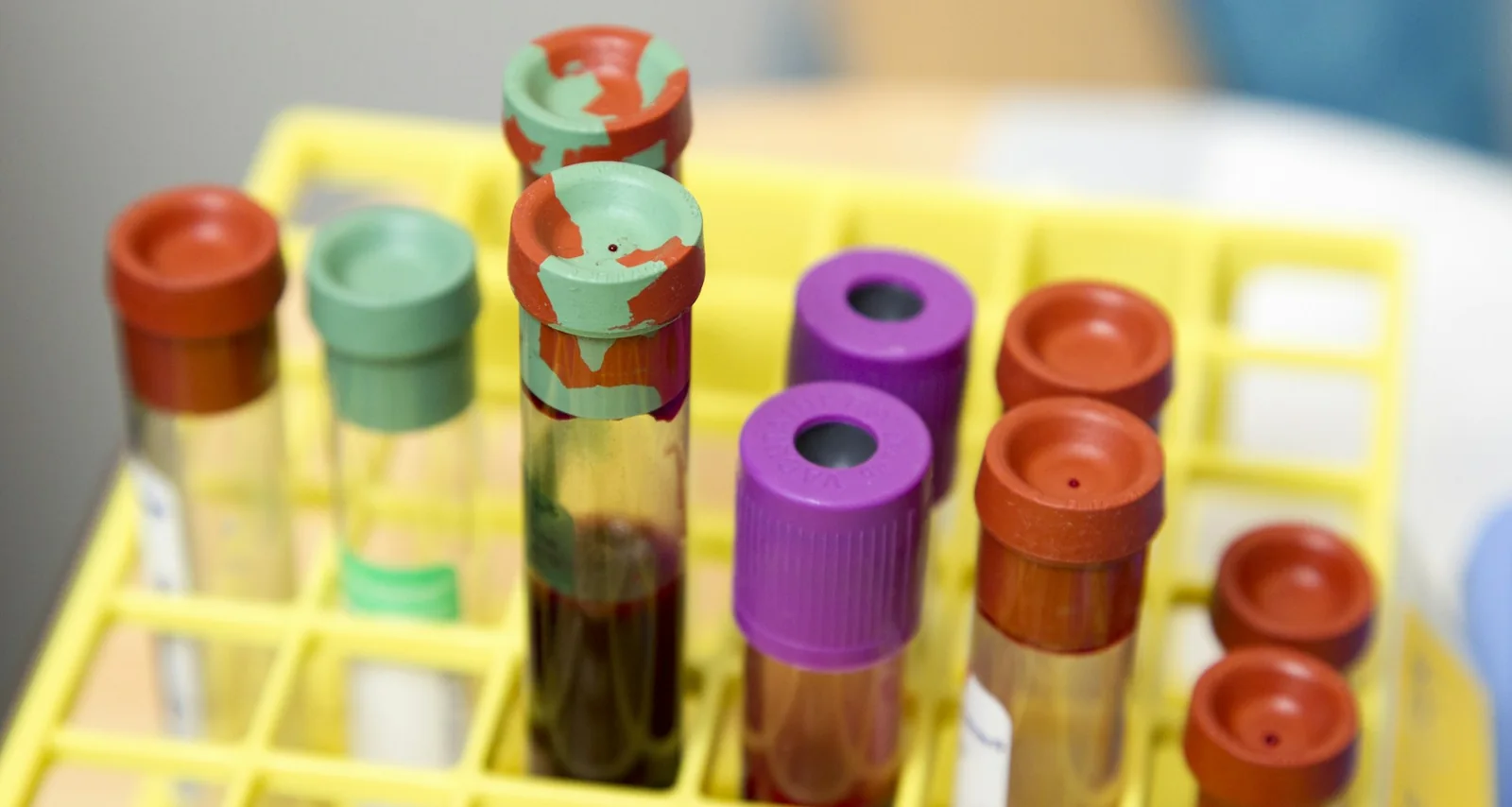
Testosterone can increase red-cell production and raise hematocrit, the fraction of blood volume occupied by red cells. A baseline complete blood count and follow-up testing help identify an excessive response. Guidelines commonly use a hematocrit around 54% as a treatment intervention threshold, while lower starting values may already need evaluation. A high result requires review of testosterone exposure and other causes, not automatic self-directed blood donation.12
Key points
- A pretreatment hematocrit threshold and an on-treatment action threshold answer different questions.12
- Studies use different cutoffs, so reported erythrocytosis rates are not directly interchangeable.34
- An observational link between higher hematocrit and events does not prove that routine phlebotomy prevents them.4
What does hematocrit measure?
Hematocrit is the percentage of blood volume occupied by red blood cells. Hemoglobin measures the oxygen-carrying protein inside those cells. Both are commonly included in a complete blood count, and both can rise when testosterone stimulates red-cell production. A testosterone concentration and a hematocrit result therefore measure different parts of treatment. 1
That distinction explains why a satisfactory testosterone level cannot substitute for a blood count. The hormone measurement asks whether exposure is appropriate at the sampling time. Hematocrit asks whether one downstream response has become excessive. People differ in that response, so the same testosterone result can coexist with different hematocrit values.
An increase is not always harmful in context. In men with confirmed hypogonadism and anemia, testosterone can help correct a low hemoglobin. Once the response becomes excessive, the same biological effect becomes a safety issue. The anemia and red-cell article explains this relationship without treating every anemia as a testosterone problem. 5
Why check the blood count before treatment?
A baseline result shows whether the blood count is already elevated and provides a comparison for later change. A high starting hematocrit should not automatically be attributed to a medicine that has not yet been started. It can reveal an additional problem that needs evaluation before treatment proceeds. 1 2
The AUA guideline advises considering withholding treatment when baseline hematocrit exceeds 50% until the cause is investigated. The Endocrine Society also treats elevated baseline hematocrit as a reason for caution and identifies a lower risk-assessment threshold in its technical discussion. These statements are not contradictions: baseline eligibility, local reference ranges and intervention during therapy are different decisions. 1 2
The clinician may assess oxygen-related contributors, sleep apnea, smoking, relevant disease and the clinical context of the sample. A complete history matters because a result cannot reveal its own cause. This is part of treatment preparation, separate from the repeated testosterone measurements used to diagnose hypogonadism.
Why do articles mention 50%, 52% and 54%?
The numbers often come from different research definitions or clinical actions. They should be labeled before they are compared. A study can count an event at one threshold while a guideline recommends intervention at another.
| Number or rule | Where it is used | What it means |
|---|---|---|
| Baseline above 50% | AUA pretreatment guidance. 2 | Consider withholding therapy while investigating the cause. |
| Above 50% | Pastuszak formulation study definition. 3 | A research event threshold used to count erythrocytosis in that cohort. |
| At least 52% | Ory observational analysis definition. 4 | A cutoff used to compare subsequent MACE/VTE associations. |
| Above 54% | Endocrine Society on-treatment guidance. 1 | Stop treatment under clinical management, evaluate contributors, and reconsider exposure before resuming. |
No single number proves that risk is absent immediately below it and suddenly appears above it. Thresholds make decisions operational. The trend, starting point, other risks and the product label still matter. A person should not deliberately wait for a result to cross an action threshold before reporting a steady rise.
Are some preparations more likely to raise hematocrit?
The formulation can influence the response. In a retrospective study of 178 men, hematocrit above 50% occurred more often in the injection group than in gel or pellet groups. The groups differed in age, baseline measures and achieved testosterone concentrations, and assignment was not randomized. 3
The study supports considering the delivery method when an excessive response develops. It does not make its event rates universal, prove a specific injection interval is responsible, or show that every gel is risk-free. Differences in treatment exposure and monitoring can partly explain differences between cohorts.
The gel and injection comparison puts that evidence beside skin transfer precautions and practical burdens. A prescriber may decide that changing the formulation is useful, but follow-up must demonstrate whether the change improves hematocrit without losing the intended treatment benefit. A route change is a hypothesis to assess, not a guaranteed correction.
Does high hematocrit mean a blood clot is inevitable?
No. A high hematocrit does not mean a clot is inevitable, but it deserves attention. Ory and colleagues compared matched men receiving testosterone who did or did not develop hematocrit of at least 52%. In the first treatment year, the combined MACE/VTE outcome occurred in 5.15% versus 3.87%, with an odds ratio of 1.35. 4
This was an observational database study. Matching can reduce measured differences but cannot eliminate every unmeasured confounder. The finding is an association, not a randomized demonstration that the hematocrit cutoff itself caused events. It also does not test whether a particular response, such as phlebotomy, reduces the risk.
The appropriate interpretation sits between dismissal and certainty. The result strengthens the reason to monitor and investigate excessive red-cell responses. It does not tell an individual the probability of a clot or justify adding an anticoagulant without an independent clinical indication. The cardiovascular evidence addresses broader outcomes in other study designs.
Why is blood donation not a complete treatment plan?
Removing blood can reduce red-cell mass, but it does not identify why hematocrit rose or whether the testosterone regimen remains appropriate. The Endocrine Society describes withholding therapy at a high hematocrit, evaluating hypoxia and sleep apnea, and considering a modified regimen once it is safe. Therapeutic phlebotomy can be part of clinical management, but it is not a substitute for that review. 1
Repeatedly arranging donation simply to keep a laboratory number below a cutoff can conceal a continuing treatment problem. It also creates another intervention whose suitability and consequences need assessment. The reviewed observational study did not establish a preventive donation schedule, and a donation center is not responsible for redesigning a hormone prescription. 4
Bring the pattern of results, exact product and sampling context to the prescribing team. A plan should specify the cause being investigated, the treatment change if any, the next blood count and the conditions for continuing. That makes the response testable rather than episodic.

How often should hematocrit be checked?
The Endocrine Society recommends checking hematocrit before treatment, at three to six months after initiation, and then annually, with more tailored follow-up when clinically indicated. Individual product labeling or a concerning trend can require closer monitoring. A standard interval is a starting framework rather than permission to ignore new information. 1
Do not use the safety schedule as a diagnostic schedule. Two morning testosterone measurements establish whether low testosterone is persistent before treatment. A later complete blood count evaluates a consequence of the therapy. The monitoring guide keeps those purposes separate.
Read the blood count in the context of its changes over time. A rise from baseline, its pace, the formulation and competing contributors are all informative. That approach allows a clinician to reassess the treatment before the laboratory result becomes the only fact driving care.
Common questions
Can I feel that my hematocrit is high?
Symptoms are not a reliable screening method. An elevated hematocrit may be discovered on a scheduled blood count, and nonspecific symptoms cannot confirm it. Routine measurement remains necessary even when treatment feels effective.1
Does a normal hematocrit mean testosterone is safe in every other way?
No. Blood pressure, fertility, prostate-related findings and other adverse effects require their own assessment. Hematocrit is one component of monitoring.1
References
- 1.Bhasin S, et al. Testosterone Therapy in Men With Hypogonadism: An Endocrine Society Clinical Practice Guideline. JCEM. 2018.
- 2.Mulhall JP, et al. Evaluation and Management of Testosterone Deficiency: AUA Guideline. Journal of Urology. 2018.
- 3.Pastuszak AW, et al. Comparison of the Effects of Testosterone Gels, Injections, and Pellets on Serum Hormones, Erythrocytosis, Lipids, and Prostate-Specific Antigen. Sexual Medicine. 2015.
- 4.Ory J, et al. Secondary Polycythemia in Men Receiving Testosterone Therapy Increases Risk of Major Adverse Cardiovascular Events and Venous Thromboembolism in the First Year of Therapy. Journal of Urology. 2022.
- 5.Pencina KM, et al. Efficacy of Testosterone Replacement Therapy in Correcting Anemia in Men With Hypogonadism: A Randomized Clinical Trial. JAMA Network Open. 2023.
This article is for general education, not medical advice, diagnosis or a treatment recommendation. A licensed clinician can interpret the evidence in the context of your symptoms, tests, medicines and fertility plans.